
Resonance of Fate Enhanced Remaster Characters: Combat Guide and Roster Breakdown
Understanding how character stats, weapon affinities, and positioning affect the flow of battle is essential for mastering the Tri-Attack system.
Resonance of Fate (known as End of Eternity in Japan) is famous for its unconventional, highly tactical, and rhythm-based combat system. When exploring the game's mechanics through the lens of a modern remaster search, players often look to understand how the iconic trio—Vashyron, Zephyr, and Leanne—function within this frantic gun-and-bullet ballet.
Understanding how character stats, weapon affinities, and positioning affect the flow of battle is essential for mastering the Tri-Attack system. This combat-focused breakdown explores the playable characters of Resonance of Fate and how they leverage the game's unique mechanics to survive the harsh, clockwork world of Basel.
The Core Trio: Overview of Playable Combatants
Unlike many traditional Japanese role-playing games where party members fulfill rigid, isolated classes, Resonance of Fate treats its three protagonists as versatile gunners. Vashyron, Zephyr, and Leanne can all equip any weapon type—Handguns, Machine Guns, and Grenade Launchers.
However, subtle differences in their animations, stat growths, and default setups give each character a distinct feel in combat. Mastering the trio requires looking past superficial cosmetic differences and understanding how they interact with the game's tactical phase system.
1. Vashyron: The Balanced Veteran
- Default Weapon: Handgun / Machine Gun versatility
- Combat Role: Anchor and flexible damage dealer
As the seasoned leader of the group, Vashyron serves as a reliable anchor during chaotic skirmishes. Statistically, he often acts as a steady baseline for health and action speed. Because players can freely swap weapon loadouts, Vashyron is frequently configured to adapt to whichever weapon type the player needs most in a given chapter. His animations offer a solid, predictable cadence, making it easy to time charged shots and multi-hit bursts without throwing off the rhythm of a Resonance Attack.
2. Zephyr: The Agile Frontliner
- Default Weapon: Typically outfitted for high-mobility strikes
- Combat Role: Aggressive momentum builder
Zephyr’s backstory and fiery personality translate into aggressive combat animations. In practice, players often assign Zephyr high-mobility roles, utilizing his movement speed to dash across complex battlefield terrain, vault over obstacles, and set up crossfire angles. Because repositioning is vital for triggering Resonance Attacks (where characters run in triangles past one another), Zephyr’s responsive movement makes him an exceptional choice for initiating tactical triangles.
3. Leanne: The Precision Operator
- Default Weapon: Often favored for long-range or status setups
- Combat Role: Combo extender and support
Leanne rounds out the trio with fluid, acrobatic animations that match her dynamic personality. In combat, players often leverage Leanne for precision strikes, setting up enemy breaks, or delivering heavy payloads via Grenade Launchers. Her movement pathing during Hero Actions can create unique geometric angles, which are crucial when the battlefield is cluttered with obstacles or enemy units blocking direct lines of sight.
Combat Mechanics: How Characters Interact with the Arsenal
The combat system in Resonance of Fate does not rely on traditional mana or spell points. Instead, character effectiveness is dictated by the interaction between two primary weapon types: Machine Guns and Handguns.
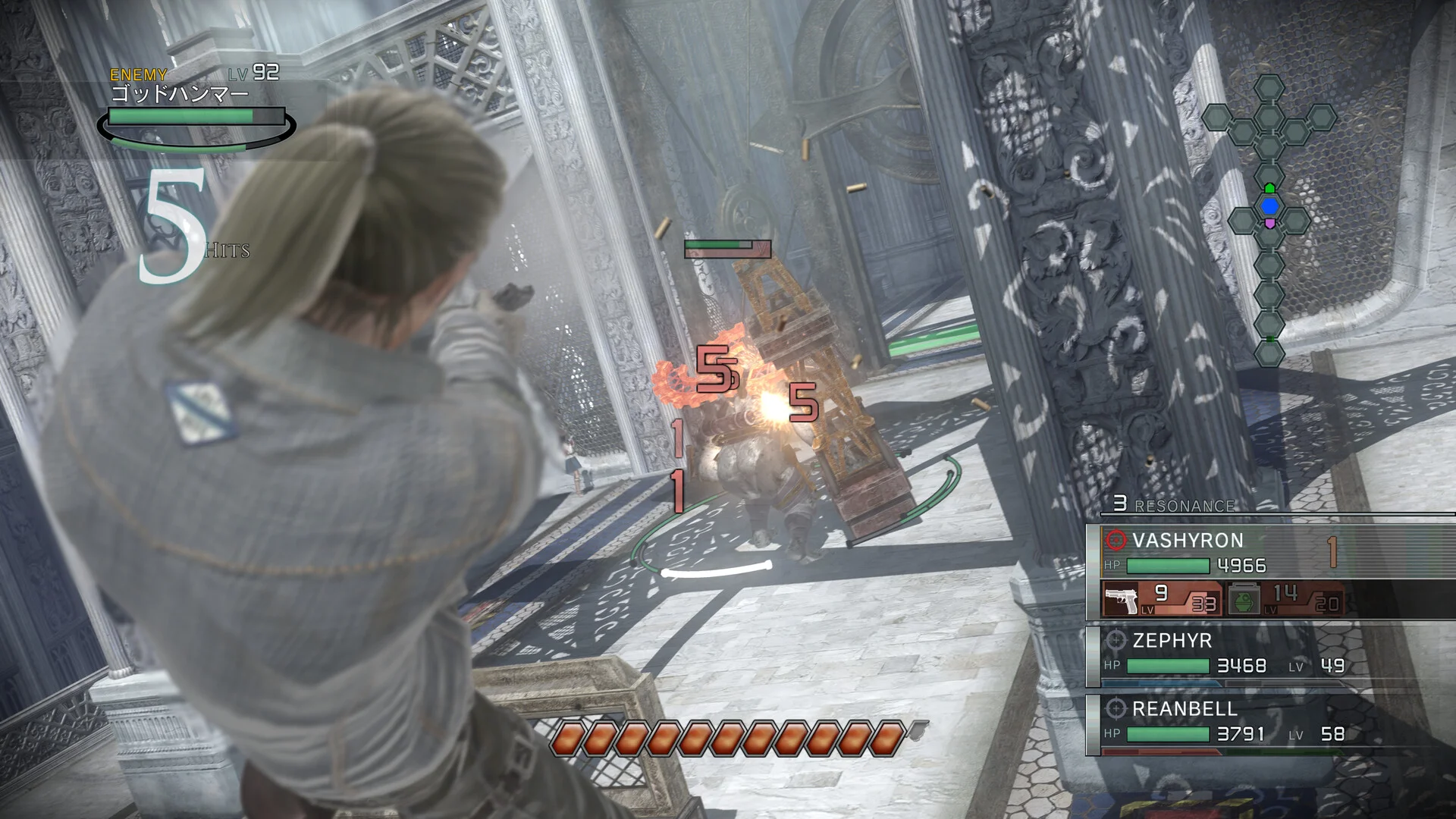
- Machine Guns (Scratch Damage): Characters equipped with machine guns deal "scratch damage," which turns an enemy's health bar orange. Scratch damage does not kill enemies on its own; it merely strips away their immediate protection.
- Handguns (Direct/Permanent Damage): Characters equipped with handguns convert accumulated scratch damage into permanent health loss and can shatter enemy armor pieces.
To succeed, characters must work in tandem. A common combat loop involves a machine gun user stripping away enemy health bars, followed immediately by a handgun user converting that scratch damage into a permanent kill.
Hero Actions and the Tri-Attack System
Characters truly shine when executing Hero Actions. By spending a Terminal Point (TP), a character can run a pre-determined path across the battlefield in real time, firing continuously.
- Resonance Attacks: If the three characters are positioned in a triangle formation, initiating a Hero Action allows them to run a circuit around that triangle. While moving along these paths, they fire a barrage of synchronized attacks.
- Character Placement: Because character positioning dictates the shape of the triangle, managing where Vashyron, Zephyr, and Leanne end their turns is a core combat puzzle. If an obstacle blocks the path between two characters, the triangle breaks, canceling the Resonance Attack and wasting precious resources.
Customization and Combat Specialization
While any character can use any weapon, min-maxing combat performance involves deep weapon customization. Players can attach barrels, scopes, magazines, and grips to guns via a grid-based puzzle interface.
- Dual-Wielding: As characters gain experience and levels, they unlock the ability to dual-wield certain weapon types—such as carrying two handguns or two machine guns simultaneously. This drastically increases their bullet output and changes their combat animation frames.
- Weight and Inertia: Adding too many custom attachments increases a weapon's weight, which can alter a character's movement speed and charge times during Hero Actions. Balancing raw firepower with mobility ensures that Vashyron, Zephyr, and Leanne remain agile enough to dodge incoming enemy attacks.
Verifying Enhanced Remaster Combat Features
If you are playing a modern digital re-release or remaster of Resonance of Fate, you may want to verify whether any backend performance adjustments, resolution scaling, or control updates have altered character handling compared to the original release.
To confirm specific technical parameters for your platform (such as framerate stability during intense multi-character Resonance Attacks or controller layout mappings):
- Check the official digital storefront page (PlayStation Store, Microsoft Store, or Steam) where you acquired the game to read patch notes and system requirements.
- Review the in-game options menu to check for graphics presets, UI scaling, or control customization features.
- Consult community hubs and updated technical wikis dedicated to the title to see if modern hardware enhancements impact input buffering or charging rhythms.
By understanding how Vashyron, Zephyr, and Leanne utilize positioning, weapon synergies, and the Tri-Attack framework, you can transform the game's punishing difficulty into a synchronized, highly rewarding combat dance.
Next guides4
 Release
Resonance of Fate Enhanced Remaster Release Date: What We Know and What to Expect
PlatformsResonance of Fate Enhanced Remaster on PS5: What to Expect from tri-Ace's Cult Classic
PlatformsPlaying Resonance of Fate on the Steam Deck: Performance, Setup, and Compatibility
Platforms