
Resonance of Fate Enhanced Remaster Review: An Unforgettable Yet Flawed JRPG Masterpiece
When discussing divisive, obscure, or outright eccentric JRPGs, Resonance of Fate (also released as End of Eternity) sits firmly in a league of its own.
When discussing divisive, obscure, or outright eccentric JRPGs, Resonance of Fate (also released as End of Eternity) sits firmly in a league of its own. Developed by tri-Ace—a studio renowned for ambitious innovation in titles like Valkyrie Profile and Star Ocean—and published by Sega, this steampunk role-playing game originally debuted in early 2010 for the Xbox 360 and PlayStation 3. Years later, in 2018, it received a new lease on life with an Enhanced Remaster for PC and PlayStation 4.
This comprehensive review dives deep into the development history, story, unique combat mechanics, overall reception, and the reasons why this cult classic remains both unforgettable and largely overlooked.
Development Ambition and Setting the Scene
Unveiled initially under the codename Project Cobra in 2007, tri-Ace set out to break traditional JRPG conventions. Lead programmer Yoshitaka Katao aimed to build a challenging yet accessible system unlike anything seen before in the genre, incorporating cinematic styles inspired by Hollywood action films like The Matrix.
The game takes place in a distant, dystopian future where environmental pollution has rendered the Earth's surface completely hazardous. To survive, humanity constructed a massive mechanical tower called Basil, which is entirely controlled by a mechanical system known as Zenith—essentially worshipped as a god.
Over time, as the original engineers disappeared and population pressures mounted, cracks began to form in society. A pivotal figure named Prolate Frida attempted to free the world from Zenith’s absolute control over human life expectancy and social status. However, a tragic disaster involving crystals called quartz—which act as a life-sustaining force—led to instantaneous deaths across Basil, including Frida herself.
The main narrative follows a small, eclectic trio of mercenaries: Vashyron, Zephyr, and Leanne. Operating out of a bustling hub, they take on assignments from powerful religious figures known as Cardinals. As the group uncovers deeper conspiracies, they learn that their world's rigid system of predetermined death and societal stratification may not be as infallible or divinely ordained as everyone believes.
Story and Presentation: Charm Meets Confusion
The story occupies a strange narrative space. On one hand, it delivers a fascinating steampunk atmosphere laced with profound themes of destiny, justice, and survival. On the other hand, it can be fiercely difficult to parse, particularly during the first half. Players are introduced to a grim dystopian backdrop that occasionally pivots into bizarre, lighthearted slice-of-life episodes—such as a chapter where Leanne is forced to go on an awkward date with one of the Cardinals.
- The Characters: Vashyron steals the show with his smug yet genuinely friendly demeanor, anchoring the team when things get dangerous. Zephyr and Leanne share an endearing, sibling-like chemistry. Leanne, in particular, experiences significant emotional growth as she moves past the trauma and fear of her past.
- The Pacing & Clarity: While the game's quirky tone grows on you, the overarching lore suffers from exposition gaps. Many background details, religious dynamics, and character motivations are left unexplained or buried behind optional NPC dialogue, leaving important narrative threads dangling by the time credits roll.
The Core Innovation: The "try-Attack" Battle System
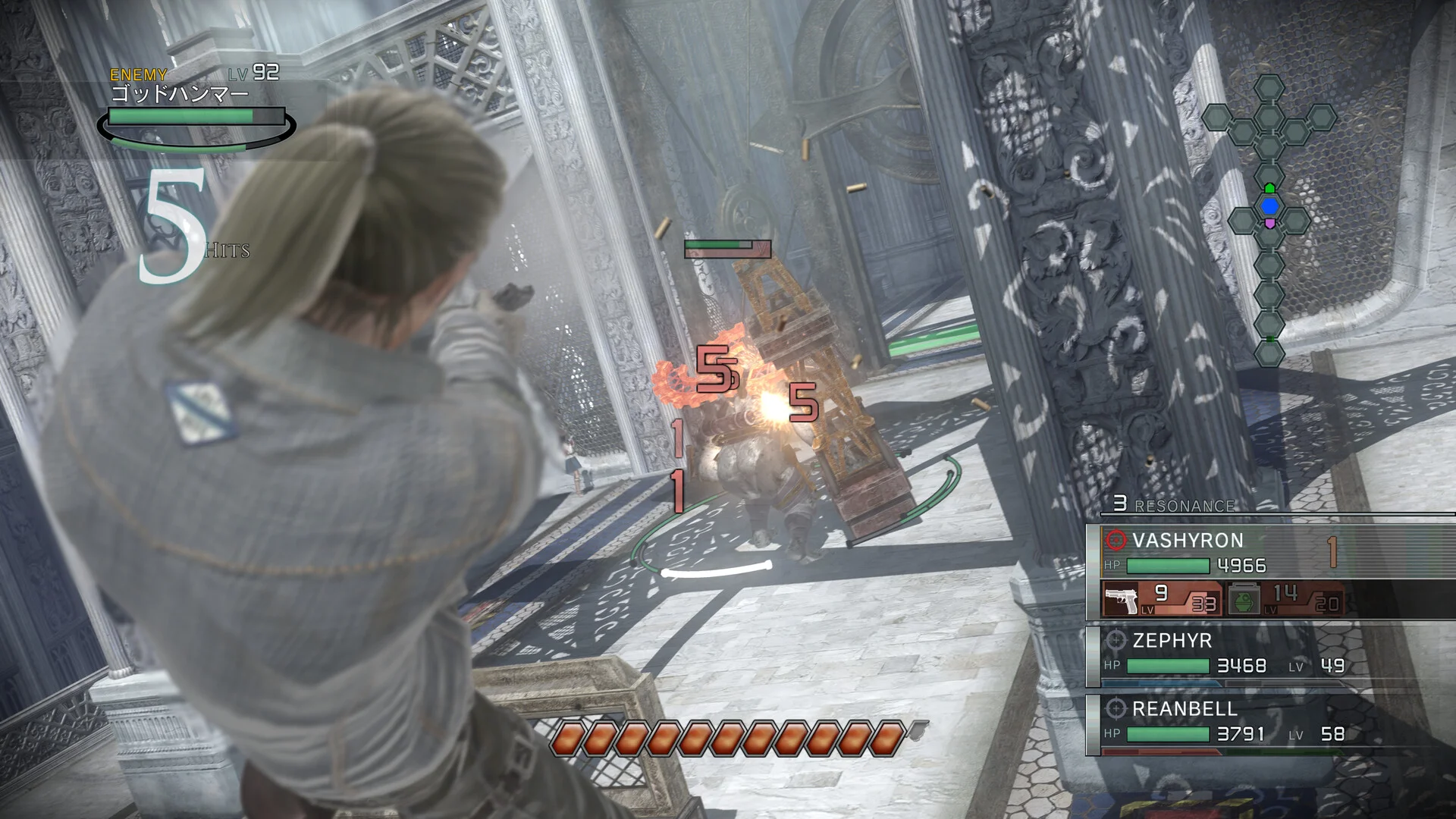
Where Resonance of Fate truly carves out its unique identity is its combat. Eschewing standard turn-based or real-time action models entirely, tri-Ace created the try-Attack Battle System, blending real-time positioning with tactical turn-based resource management.
Firearms and the Dual-Damage System
Combat revolves primarily around firearms, split into two distinct categories:
- Standard Pistols: Deal direct HP damage, converting temporary damage into permanent health reduction.
- Machine Guns / SMGs: Deal scratch damage. This doesn't deplete enemy health bars directly, but it turns a large portion of the enemy's green health bar blue, making them vulnerable to a follow-up pistol strike.
Hero Actions and the Bezel System
To excel in combat, players must master Hero Actions. Characters run dynamically across the battlefield in cinematic arcs, unleashing a continuous barrage of gunfire while moving from point to point.
However, these maneuvers consume bezels—the team's shared action resource pool. Running out of bezels places your party in a "Danger State," rendering them slow, defenseless, and unable to execute Hero Actions while enemies grow aggressively relentless.
Resonance and Gun Customization
By positioning characters so their movement paths intersect during Hero Actions, you accumulate resonance. Spending resonance triggers a try-Attack, forming a geometric triangle on the battlefield that unleashes a devastating, simultaneous barrage of bullets from all three party members.
Beyond combat execution, weapon upgrading is deeply analytical. Instead of acquiring brand-new weapons, you customize individual parts—such as scopes, barrels, and extended magazines—fitting them together onto a grid-like diagram to optimize your firearm's stats and physical appearance.
Flaws, Repetition, and Difficulty
Despite its brilliant combat framework, Resonance of Fate harbors notable shortcomings:
- Mission Structure and Repetition: The game relies heavily on an episodic format. Once you master the combat system early on, the gameplay loop can feel repetitive: accept a mission, travel across the world map grid, clear out enemies in a dungeon, defeat a boss, and conclude the chapter.
- Unforgiving Difficulty: The game features no difficulty selector, and bosses can act as brutal brick walls. Mechanics like the bezel system, positioning requirements, and unforgiving enemy counters mean that a single mistimed move can lead to an abrupt, punishing defeat.
Reception and Why It Became Obscure
Upon its original 2010 release, Resonance of Fate received generally favorable reviews, hovering around 7 out of 10. Critics praised its daring, inspired approach to JRPG combat and unique art direction, while remaining mixed on its uneven story delivery. Financially, it had a respectable opening week in Japan, moving around 145,000 units.
However, the game ultimately slipped into relative obscurity due to two major factors:
- Lack of Marketing: Minimal advertising left mainstream audiences largely unaware of its existence, both during its initial launch and its subsequent digital re-releases.
- Unfortunate Release Timing: Sega chose to launch Resonance of Fate just a few days after Final Fantasy XIII—a massive, highly anticipated blockbuster that completely dominated consumer attention and oxygen in the JRPG space.
Verdict
Resonance of Fate Enhanced Remaster presents a fascinating, deeply unconventional experience that you truly need to see to believe. While its narrative pacing is erratic and its learning curve is notoriously steep, its brilliantly complex combat system, stylish steampunk aesthetic, and memorable character chemistry make it a standout title for adventurous RPG fans willing to look past its rough edges.
Next guides4
 Release
Resonance of Fate Enhanced Remaster Release Date: What We Know and What to Expect
PlatformsResonance of Fate Enhanced Remaster on PS5: What to Expect from tri-Ace's Cult Classic
PlatformsPlaying Resonance of Fate on the Steam Deck: Performance, Setup, and Compatibility
Platforms