
Resonance of Fate Enhanced Remaster Speedrun: Categories, Routes, and Tips
Whether you are looking to break records in Any% or test your endurance in 100% completion categories, understanding the game's unique mechanical quirks is.
Resonance of Fate (known as End of Eternity in Japan) is notoriously punishing. Developed by tri-Ace and published by Sega, its tactical, semi-real-time combat system relies heavily on positioning, weapon customization, charge phases, and terminal-board grid management. When players pivot toward a Resonance of Fate Enhanced Remaster speedrun, the game shifts from a grueling tactical RPG into a high-execution puzzle box where route optimization, damage scaling, and menuing dictate success.
Whether you are looking to break records in Any% or test your endurance in 100% completion categories, understanding the game's unique mechanical quirks is essential. Because direct re-releases and modern ports often alter minor loading times and stability, runners must adapt standard strategies to the platform they choose.
Understanding Speedrun Categories for Resonance of Fate
Before diving into a run, it is vital to understand how the speedrunning community categorizes attempts for this title.
Any%
The standard Any% category requires runners to complete the main story—defeating the final boss—as quickly as possible.
- Core Focus: Minimizing mandatory side content, aggressive skipping of unskippable cutscenes where possible, and routing the most efficient path through the world map's hex grid.
- Key Challenge: Balancing low-level character stats against late-game bosses who can easily wipe an under-leveled party in a single turn.
100% Completion
For those seeking a monumental endurance test, 100% categories usually require clearing all optional chapters, unlocking every terminal bonus, clearing massive side dungeons like Neverland, and acquiring ultimate gear.
- Core Focus: Deep route planning to minimize backtracking across the hexagonal map and maximizing terminal placement efficiency for experience and drop multipliers.
Individual Levels (ILs) or Chapter Runs
Runners often practice specific chapters to hone their execution of difficult boss encounters or complex movement phases without committing to a 40+ hour full-game marathon.
Route Planning and World Map Mastery
The world map in Resonance of Fate is structured like a dense board game. Progress requires unlocking grid squares using energy cells of various shapes and colors, activating stationary terminals that grant passive buffs (such as increased drop rates or reduced enemy encounters), and connecting those terminals via colored paths.
Hex Management in a Speedrun
Casual playthroughs encourage mapping out every inch of Ebel City and the surrounding zones. In a speedrun, every wasted energy cell or unnecessary diversion costs precious seconds.
- Energy Cell Conservation: Runners must memorize exact cell placements to unlock mandatory story paths without wasting time farming rare shapes from specific enemy types.
- Terminal Activation: Knowing which terminals are worth the detour—and which can be entirely ignored—separates a casual run from a competitive one. Combat buffs that reduce enemy encounter rates or boost scratch damage efficiency often dictate the path.
Minimizing Encounters
While grinding is generally avoided in Any% runs, completely bypassing encounters can leave your party severely underpowered for checkpoint bosses. Runners calculate a precise threshold of mandatory fights to ensure character levels and weapon skill levels scale sufficiently to survive later chapters.
Combat Optimization for Rapid Boss Meltdowns
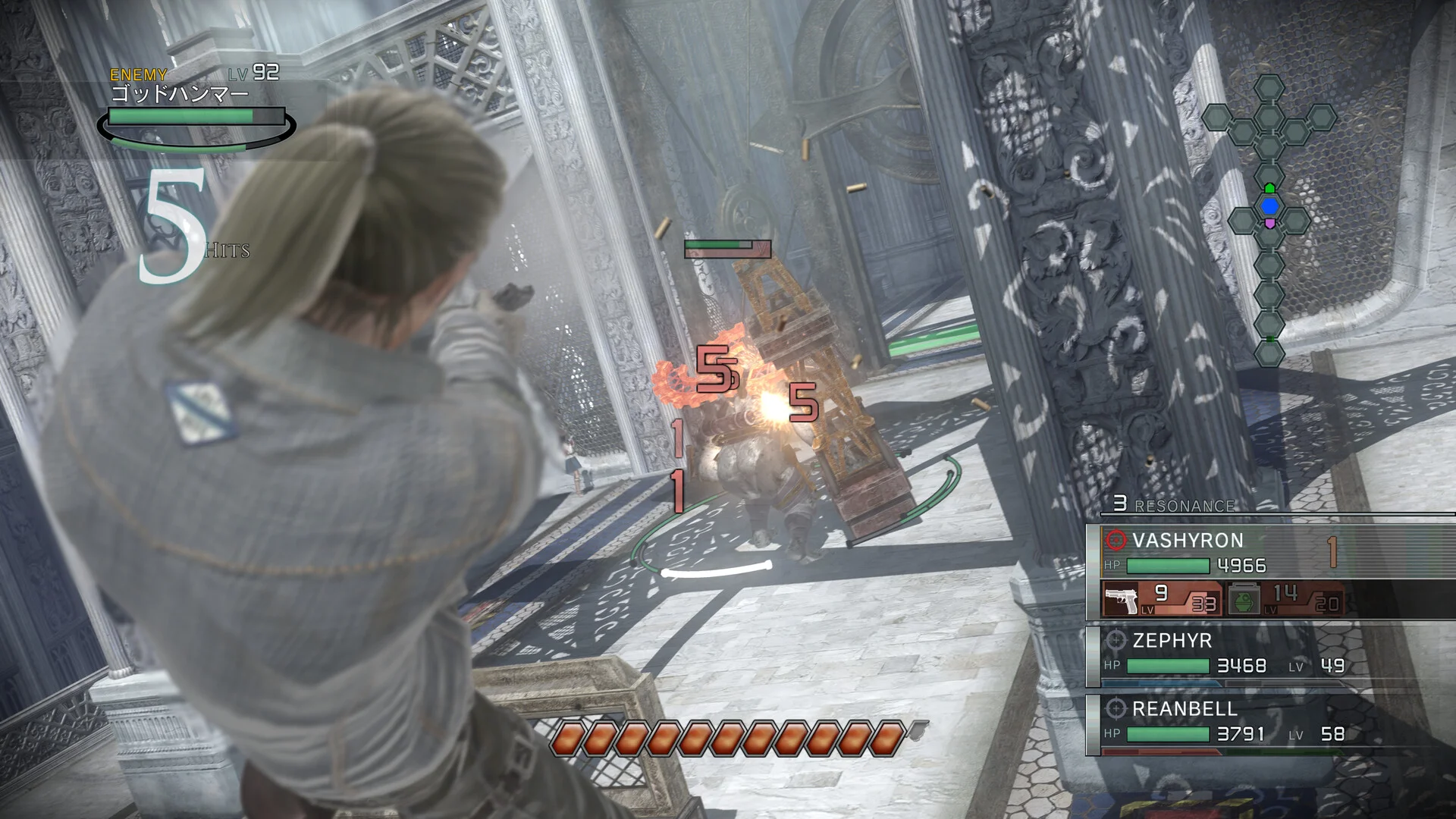
Combat is the defining element of Resonance of Fate. Mastering the Tri-Attack (Hero Run), Resonance Attacks, and scratch-to-direct damage conversion is the single biggest time-saver in any run.
Scratch Damage vs. Direct Damage
Standard play encourages building up scratch damage with machine pistols and converting it into permanent HP damage with handguns. In a speedrun, efficiency is everything:
- Weapon Tuning: Knowing which scopes, barrels, and magazine cases to attach—and when to upgrade them at the Tinkerer—drastically reduces boss fight durations.
- Positioning: Triggering Hero Runs so that characters cross paths to initiate Resonance Attacks creates massive multi-hit chains that can break armor and deplete health bars before enemies can retaliate.
Turn Order Manipulation
The turn gauge operates on a continuous meter based on bezel movement and character movement paths. Managing your bezels (action points) so you never run out mid-run—or knowing when to sacrifice a bezel to trigger a life-saving retreat—prevents costly game-over screens that can ruin an entire attempt.
Execution Tips for Runners
If you are planning to time your own runs or submit times to leaderboards, keep these practical tips in mind:
- Master the Menuing: Menu navigation during combat pauses (like selecting grenades or changing ammo types) adds up over a long run. Practice inventory management so you can swap gear without hesitating.
- Mitigate RNG Risks: Certain enemy groups have unpredictable movement patterns or aggressive attack frequencies that can ruin a clean execution. Learn safe positioning tricks to manipulate enemy AI where possible.
- Verify Platform Differences: Load times, frame rate stability, and input responsiveness can vary depending on whether you are running the original release or a modern digital port. Check current community leaderboards to see which version is preferred or if separate sub-categories exist for specific hardware.
How to Verify Current Speedrun Standards
Because speedrunning communities constantly evolve routes, discover new glitches, and update rulesets, it is always wise to check active resources directly:
- Visit community-run leaderboards (such as Speedrun.com) for Resonance of Fate to inspect current record-holder video archives.
- Look for route notes and routing documents shared in community Discord servers or forums dedicated to tri-Ace RPG speedruns.
- Compare notes on newer patch updates or enhanced versions to confirm whether loading optimizations or bug fixes have invalidated older legacy routes.
Next guides4
 Release
Resonance of Fate Enhanced Remaster Release Date: What We Know and What to Expect
PlatformsResonance of Fate Enhanced Remaster on PS5: What to Expect from tri-Ace's Cult Classic
PlatformsPlaying Resonance of Fate on the Steam Deck: Performance, Setup, and Compatibility
Platforms